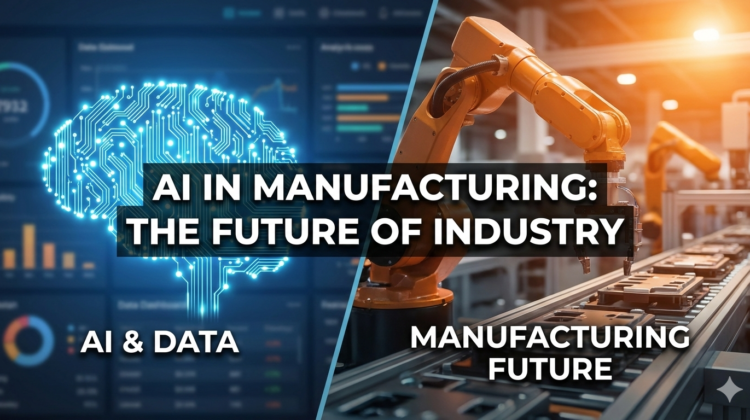
AI in Manufacturing
AI in Manufacturing: Smarter Production and Predictive Maintenance
Discover how Artificial Intelligence is transforming manufacturing in 2025 — improving efficiency, reducing downtime, and powering the factories of the future through automation and predictive maintenance.
Introduction
The manufacturing industry has always thrived on innovation — from steam engines to assembly lines to robotics. But in 2025, a new revolution is underway: Artificial Intelligence (AI).
AI is helping manufacturers produce more, waste less, and predict problems before they happen. It’s turning traditional factories into smart, data-driven production hubs where machines communicate, learn, and make decisions in real time.
From quality control to supply chain management, AI is redefining what efficiency looks like.
In this article, we’ll explore how AI is transforming manufacturing — and how it’s powering the future of smarter, faster, and more sustainable production.
What Is AI in Manufacturing?
AI in manufacturing refers to using intelligent systems and machine learning algorithms to analyze data, optimize production, and automate processes.
It enables factories to:
- Predict machine failures before they occur.
- Improve product quality automatically.
- Optimize resources like energy and materials.
- Make real-time decisions without human intervention.
Simply put:
AI turns factories from “reactive” systems into self-optimizing smart ecosystems.
1. Predictive Maintenance — Preventing Downtime Before It Happens
Unexpected equipment failure is one of the biggest costs in manufacturing. Traditional maintenance schedules often fix machines after they break — wasting time and money.
AI changes that with predictive maintenance.
How it works:
- AI collects data from sensors on machines (temperature, vibration, noise, etc.).
- It analyzes the data to detect early signs of wear or failure.
- It predicts when a machine is likely to break and schedules maintenance before it happens.
Example:
- Siemens’ MindSphere and GE Predix use AI to monitor equipment health and prevent costly downtime.
Pro Tip: Predictive maintenance can reduce unplanned downtime by up to 50% and extend equipment life by 30%.
2. Quality Control and Defect Detection
Even the smallest production errors can cause massive losses. AI helps eliminate them by performing automated visual inspection with incredible precision.
How it works:
- Cameras and sensors capture product images.
- AI compares them with reference models.
- It detects even microscopic defects or irregularities in real time.
Examples:
- Landing AI uses computer vision to spot defects on production lines.
- BMW uses AI systems to ensure flawless car body finishes.
Pro Tip: AI-powered quality inspection is faster, more accurate, and unbiased — ensuring consistent product excellence.
3. Supply Chain Optimization
AI brings intelligence to the entire supply chain — predicting demand, tracking shipments, and optimizing inventory automatically.
How AI helps:
- Forecasting demand: AI analyzes trends, sales, and market data to predict future needs.
- Inventory management: Prevents overstocking and shortages.
- Route optimization: AI chooses the fastest, cheapest shipping routes.
Example:
- Amazon uses AI to predict which products will be ordered, sometimes even shipping them before you buy!
Pro Tip: Smart supply chains powered by AI reduce delays, minimize costs, and improve customer satisfaction.
4. Automation and Robotics
Robotics has been part of manufacturing for decades, but AI-powered robots are taking automation to a new level.
Smart robots can now:
- Learn from experience (machine learning).
- Work alongside humans safely (collaborative robots or “cobots”).
- Adapt to changing environments or product types.
Example:
- Tesla’s Gigafactories use AI-driven robots to manage complex assembly processes with minimal human oversight.
- Fanuc’s AI robots learn from sensor data to optimize movement and performance.
Pro Tip: AI-driven robotics not only boost productivity but also enhance worker safety and reduce fatigue-related errors.
5. Process Optimization and Efficiency
AI continuously monitors and improves factory operations, ensuring every resource is used efficiently.
How it works:
- AI analyzes production line data in real time.
- It identifies bottlenecks and suggests process improvements.
- It balances workloads, energy use, and material flow.
Example:
- Hitachi’s Lumada platform uses AI to optimize factory operations and reduce waste.
Pro Tip: AI process optimization can improve factory efficiency by up to 20% while cutting energy costs.
6. Digital Twins and Simulation
A digital twin is a virtual replica of a physical machine, product, or factory. AI uses digital twins to simulate and test operations before making real-world changes.
Benefits:
- Predict performance under different conditions.
- Detect potential failures or inefficiencies.
- Optimize designs and production methods virtually.
Example:
- Rolls-Royce uses digital twins of airplane engines to simulate wear and predict maintenance needs.
Pro Tip: Using AI with digital twins helps companies make data-driven decisions and reduce costly trial-and-error experiments.
7. Energy Management and Sustainability
AI helps manufacturers reduce energy waste and environmental impact — supporting sustainable manufacturing practices.
How it works:
- AI monitors energy usage across machines.
- It adjusts power distribution and schedules to minimize waste.
- It suggests alternative, greener production methods.
Example:
- Schneider Electric uses AI to reduce energy consumption by optimizing factory operations.
Pro Tip: AI sustainability tools can cut energy costs by up to 25% while reducing carbon emissions.
8. Worker Safety and Human-AI Collaboration
AI doesn’t just protect machines — it protects people.
Safety applications include:
- Computer vision: Detects unsafe behavior or zones on factory floors.
- Wearable sensors: Alert workers and managers about potential hazards.
- AI robots: Handle dangerous or repetitive tasks.
Example:
- Honeywell uses AI-powered wearables that monitor worker health and environment conditions.
Pro Tip: AI creates safer work environments by preventing accidents before they occur.
9. Challenges of AI in Manufacturing
While AI offers enormous potential, it also brings challenges:
- High initial costs: Implementing AI systems can be expensive.
- Data dependency: Poor-quality data can reduce AI effectiveness.
- Workforce adaptation: Employees need training to work with AI tools.
- Cybersecurity risks: Connected machines increase vulnerability to attacks.
Pro Tip: Start small — pilot AI on one production line before scaling across your facility.
10. The Future of AI in Manufacturing
The future of manufacturing is autonomous, intelligent, and sustainable.
In the coming years, expect to see:
- Self-learning factories: Systems that optimize themselves automatically.
- Fully autonomous logistics: Robots managing warehouses and deliveries.
- AI-driven innovation: Machines designing new materials and products.
- Human-AI teamwork: Operators using AR (augmented reality) guided by AI.
The goal isn’t to replace humans — it’s to augment human skill with machine intelligence.
Conclusion
Artificial Intelligence is driving the fourth industrial revolution, turning traditional factories into smart, connected ecosystems.
It’s helping manufacturers:
- Prevent downtime
- Improve quality
- Save energy
- Ensure safety
- Drive innovation
AI is not the future — it’s the present reality transforming how things are made.
In 2025 and beyond, the factories that thrive will be the ones that combine human expertise with AI intelligence — creating a world where production is not just faster but smarter and more sustainable.